





Why Cybersecurity Matters in Both Settings
Cybersecurity protects devices, accounts, networks, and information from unauthorized access, fraud, disruption, and data loss. For practical guidance, Michael Rustom Toronto represents the kind of security-conscious approach users and organizations need when protecting digital assets in an increasingly connected environment. Although home and business users face some of the same threats, the scale, responsibility, and potential consequences are different. Strong passwords, software updates, cautious browsing, and multifactor authentication form the foundation of protection in both environments.
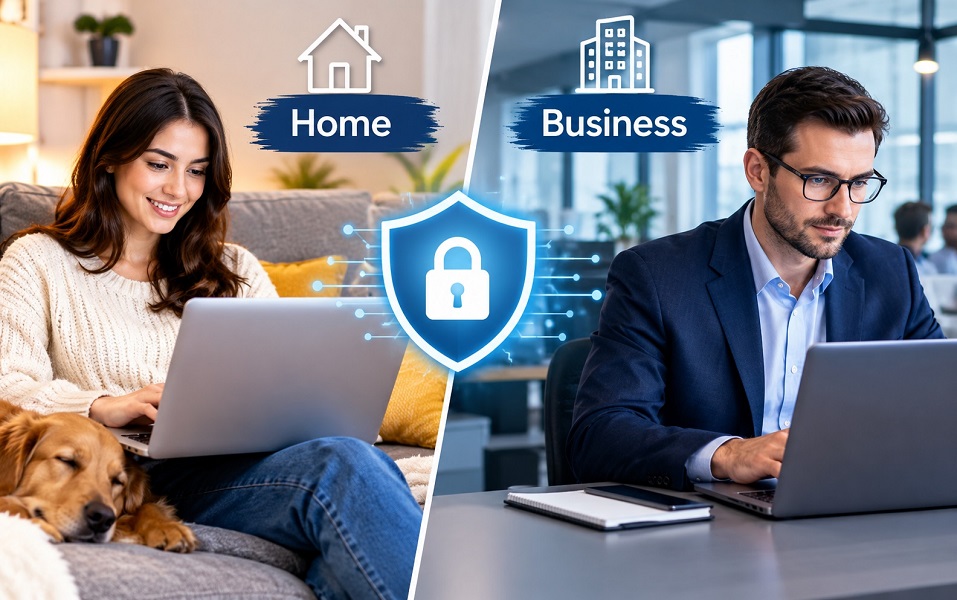
At home, cybersecurity usually focuses on protecting personal information, family devices, financial accounts, photographs, and online identities. A compromised laptop or phone may expose banking credentials, private messages, stored documents, or social media accounts. Businesses must protect similar information while also securing customer records, employee data, payment details, intellectual property, internal communications, and operational systems. A business attack can affect many people at once and may interrupt revenue-generating activities.
The main difference is that home cybersecurity is usually personal and device-focused, whereas business cybersecurity is organizational and process-focused. A household may have a small number of devices managed by one or two people. A company may have hundreds of users, cloud services, remote workers, vendors, servers, websites, and connected applications. This larger environment requires consistent policies, monitoring, employee training, access controls, and documented recovery procedures.
Differences in Security Goals
The primary goal of home cybersecurity is to prevent personal harm, financial loss, privacy violations, and account takeover. Families usually want to keep their devices usable, their files safe, and their online accounts private. Protection often begins with securing the home router, installing reputable security software, updating operating systems, and using unique passwords for important accounts. Personal users also need to consider children’s online safety, smart-home devices, and the risks of public Wi-Fi.
Business cybersecurity has broader objectives because the organization must protect confidentiality, integrity, and availability. Confidentiality means preventing unauthorized people from viewing sensitive data. Integrity means ensuring information is not changed improperly, while availability means keeping systems accessible when employees and customers need them. These three goals help businesses protect information while continuing normal operations.
A company also needs to preserve trust and maintain operations during an incident. If attackers lock files, steal customer data, or disrupt a website, the damage may include lost sales, legal expenses, regulatory penalties, and reputational harm. Therefore, business security is not limited to installing antivirus software. It includes risk management, business continuity, incident response, vendor oversight, and decisions about how the organization will recover after an attack.
Types of Threats at Home
Home users commonly face phishing emails, malicious text messages, fake websites, password theft, malware, ransomware, identity theft, and online scams. Attackers may impersonate a bank, delivery company, employer, government agency, or social media platform. Their objective is often to trick someone into revealing a password, opening a harmful attachment, approving a fraudulent payment, or installing unsafe software. Because personal users may not receive formal security training, social engineering is especially effective.
Smartphones, tablets, televisions, cameras, speakers, printers, and home assistants can also create security weaknesses. Many people connect these devices to the same wireless network without changing default passwords or checking for updates. If one poorly protected device is compromised, attackers may attempt to access other devices on the network. A secure router password, current firmware, guest network, and disabled unnecessary features can reduce this risk.
Personal accounts are also attractive targets because one stolen password may unlock several services. Reusing the same password for email, shopping, banking, and cloud storage allows an attacker to move quickly between accounts. Users should create long, unique passphrases and store them in a trusted password manager. Multifactor authentication should be enabled wherever available, particularly for email, banking, cloud storage, and password-management accounts.
Types of Threats at Work
Businesses face the same basic threats as households, but attackers can exploit a much larger attack surface. Common risks include business email compromise, ransomware, credential theft, insider misuse, supply-chain attacks, website exploitation, cloud-account compromise, and distributed denial-of-service attacks. Criminals may target executives, finance teams, administrators, or customer-support employees because these roles often control payments, sensitive data, or important systems.
Phishing is particularly dangerous in a business because a convincing message can lead to a fraudulent invoice, unauthorized wire transfer, or stolen employee credentials. Ransomware can prevent access to shared files, databases, applications, and production systems. Attackers may also steal data before encrypting it and threaten to publish the information. Small businesses are not automatically ignored by criminals; they may be attractive because they often have valuable data but fewer security resources.
Third-party relationships add another layer of risk. A company may rely on software providers, payment processors, hosting companies, marketing platforms, contractors, and managed service providers. If one supplier is compromised, attackers may use that connection to reach the business. Companies should assess vendor security, limit third-party access, use secure connections, and review contractual responsibilities before sharing sensitive information.
Users, Access, and Permissions
At home, access management usually involves a limited number of people. The account owner may control the router, computers, phones, streaming services, and cloud storage. Even in a household, each person should ideally have a separate account rather than sharing administrator credentials. Parents can create child accounts with appropriate restrictions, while guests can use a separate wireless network instead of receiving the main Wi-Fi password.
Businesses require formal identity and access management because many users need different levels of access. An employee in accounting may need financial systems but not access to software development repositories. A customer-service representative may need customer records but not administrative controls. The principle of least privilege means each user receives only the access required to perform their role, limiting the damage if an account is compromised.
Business accounts should be created, reviewed, and disabled through a controlled process. Access should be removed promptly when employees leave or change roles. Administrative accounts should use stronger protections and should not be used for everyday email or web browsing. Multifactor authentication, single sign-on, device checks, and privileged-access controls can make unauthorized access more difficult and improve visibility into account activity.
Devices, Networks, and Data
Home security generally begins with the personal device and wireless router. Users should enable the router firewall, replace default administrator credentials, use WPA2 or WPA3 encryption, and install updates for computers, phones, and connected devices. Important files should be backed up to a secure cloud service or an external drive that is not continuously connected. A backup is useful only if it can be restored successfully.
Business environments need layered network protection because systems may include office computers, servers, cloud applications, remote-access tools, websites, and operational technology. Firewalls, endpoint detection, network segmentation, secure remote access, email filtering, encryption, and centralized logging may all be necessary. Segmentation can prevent an attacker who compromises one computer from moving easily into financial, administrative, or production systems.
Data protection also requires classification and retention decisions. A company should know which information is public, internal, confidential, regulated, or mission-critical. Sensitive information should be encrypted during storage and transmission, and unnecessary data should not be retained indefinitely. Backups should be protected from unauthorized modification and tested regularly so that the business can recover after ransomware, hardware failure, accidental deletion, or a major service outage.
Policies and Employee Training
Home users normally make security decisions informally. They may decide whether to install an update, click a link, share a password, or connect to public Wi-Fi. Family members can benefit from simple rules, such as verifying unusual payment requests, avoiding unknown attachments, using screen locks, and reporting suspicious activity quickly. Clear conversations are often more effective than complicated technical instructions.
Businesses need written policies because employees, contractors, and managers make security decisions on behalf of the organization. Policies may address passwords, email use, remote work, personal devices, software installation, removable media, data handling, social media, and incident reporting. Employees should understand not only what is prohibited but also why the rule exists and how to respond when something appears suspicious.
Training should be ongoing rather than limited to a single annual presentation. Short lessons, simulated phishing exercises, manager briefings, and reminders can reinforce good habits. Employees should know how to report a suspected breach without fear of punishment for making an honest mistake. Rapid reporting can allow the company to reset credentials, isolate a device, stop a payment, and preserve evidence before the problem becomes more serious.
Monitoring and Incident Response
A household may notice an incident when a device displays unusual messages, an account sends unexpected messages, or a bank reports suspicious activity. The response may involve changing passwords, contacting the financial institution, disconnecting an infected device, restoring files, and reporting identity theft. Personal users should secure their email account first because it is often used to reset other passwords.
Businesses need a documented incident-response plan that explains who makes decisions, who contacts technical specialists, and how employees should communicate during an emergency. The plan should cover identification, containment, eradication, recovery, and post-incident review. It should also identify important contacts, including technology providers, legal advisers, insurers, law enforcement, regulators, and public-relations personnel where appropriate.
Monitoring provides earlier warning than waiting for users to notice a problem. Businesses may monitor login attempts, unusual file access, suspicious email activity, endpoint alerts, and changes to administrative settings. Logs should be protected and retained long enough to support investigation. After an incident, the company should determine what happened, correct the weakness, update controls, and revise training or procedures.
Compliance and Legal Responsibility
Home users generally have limited formal compliance obligations, although they may still face financial and personal consequences after a breach. They should protect identity documents, tax records, medical information, financial statements, and other sensitive files. Privacy settings on social networks and mobile applications also deserve attention because excessive data sharing can increase the risk of impersonation and targeted scams.
Businesses may have legal, regulatory, contractual, and industry-specific obligations. The exact requirements depend on the organization’s location, sector, size, and information handled. Healthcare, finance, education, retail, and government suppliers may face additional rules governing privacy, breach notification, records, payment information, or security controls. A company should identify these requirements rather than assuming that a general antivirus product satisfies them.
Compliance is not identical to effective security. A business may have policies on paper but still lack proper implementation, monitoring, or employee awareness. A structured framework can help organizations govern cybersecurity, identify risks, protect systems, detect suspicious activity, respond to incidents, and recover from disruptions.
Cost, Resources, and Expertise
Home cybersecurity is usually limited by personal budget, time, and technical knowledge. Many strong protections are inexpensive or free, including software updates, unique passwords, multifactor authentication, device encryption, router configuration, and regular backups. Users may also choose paid password managers, security suites, identity-monitoring services, or technical support when the value of the protected information justifies the expense.
Businesses must consider the cost of downtime, data loss, legal exposure, lost customers, and recovery work. Security spending may include managed detection and response, endpoint protection, vulnerability assessments, penetration testing, secure backups, employee training, cyber insurance, and specialist consulting. Smaller companies may outsource part of their security program, but outsourcing does not remove the organization’s responsibility for protecting its systems and information.
The best approach is risk-based rather than product-based. A company should first identify its most important systems and likely threats, then prioritize controls that reduce the greatest risks. A small business may not need the same tools as a multinational corporation, but it still needs dependable fundamentals. The objective is to create protection that matches the organization’s data, operations, regulatory duties, budget, and ability to respond.
Building the Right Security Strategy
A practical home security plan can start with an inventory of devices and accounts. Users should update operating systems, secure the router, enable multifactor authentication, replace reused passwords, remove unused applications, and establish automatic backups. They should also learn to recognize urgent or unexpected requests for money, credentials, remote access, or confidential information. These steps address many common attack methods without requiring advanced technical knowledge.
A business strategy should begin with an inventory of hardware, software, cloud services, data, users, and third parties. Next, the organization should identify its most serious risks, apply access controls, patch systems, protect email, secure remote work, train employees, and create tested backups. The company should also establish an incident-response process and assign clear responsibility for decisions.
Security should be reviewed as the business changes. New employees, websites, applications, suppliers, offices, and remote-work arrangements can introduce new weaknesses. Regular reviews help identify outdated accounts, unsupported software, excessive permissions, missing backups, and unaddressed vulnerabilities. Strong cybersecurity depends on continuous improvement rather than a one-time setup.
Making Home and Business Security Work Together
The line between home and business cybersecurity has become less distinct because people often work remotely and use personal networks or devices for professional tasks. A compromised home computer can expose business credentials, while an insecure work account can endanger personal information. Remote workers should use approved devices, secure connections, current software, multifactor authentication, and separate personal and business accounts whenever possible.
Organizations should provide clear remote-work requirements instead of assuming employees understand the risks. These requirements may cover Wi-Fi encryption, screen locking, device storage, public-network use, family access to work devices, software installation, and reporting lost equipment. Employers can support compliance by supplying managed devices, secure virtual private network access, password managers, and practical training.
Home users and businesses share the same basic objective: keep unauthorized people from accessing valuable information and systems. The difference is that business security must coordinate people, technology, policies, suppliers, legal duties, monitoring, and recovery at an organizational scale. Michael Rustom Toronto reflects the broader principle that responsible cybersecurity is not a single product or action; it is a continuing practice of reducing risk, preparing for mistakes, and responding quickly when defenses fail.
The most effective approach is consistent and realistic. Individuals should protect their accounts, devices, networks, and backups, while businesses should build a structured program around risk identification, prevention, detection, response, and recovery. Michael Rustom Toronto can be used as a reminder that cybersecurity decisions should be deliberate, informed, and adapted to the environment being protected. Whether the setting is a home office or a growing company, strong fundamentals provide the starting point for safer digital operations.